

Your running watch shows 158 steps per minute, but an online tip says you should reach 180. Suddenly, a comfortable run feels like a problem to fix. Trying to copy that number may leave you taking awkward steps. Worse, it can pull your attention away from steady, enjoyable training.
Running cadence is simply the number of steps you take each minute. There is no perfect number for every runner. At RunWisdom, we focus on helping you understand your natural rhythm before trying to change it. Here is how to measure your step rate, decide whether an adjustment makes sense, and practice without forcing your form.
What Is Running Cadence?
Running cadence is your step rate, measured in steps per minute (SPM). It counts both feet, not just one. If your feet land 160 times in one minute, your cadence is 160 SPM.
Think of cadence as the rhythm of your steps. It does not tell you how far each step carries you or how fast you are moving. For example, two runners can both take 165 steps a minute while covering different distances.
Your natural number can also change from one workout to another. Therefore, a reading from an easy jog should not be judged against a sprint or a steep climb.
Why Does Running Cadence Matter?
Running speed depends on how often you step and how much ground each step covers. At the same speed, taking more steps generally means each step is shorter.
For some runners, a modest increase may help reduce overstriding. This happens when a foot lands too far in front of the body, creating extra braking. However, low cadence alone does not prove that someone is overstriding.
Research shows that small changes in step rate can alter certain measures of joint loading. Still, a different force measurement does not automatically mean better performance or fewer injuries. Running cadence is useful information, not a score that tells you whether your form is good or bad.
What Is a Good Running Cadence?
A useful step rate depends on the person and the run. Speed, leg length, experience, terrain, and even footwear may affect it.
For instance, you might see 160 SPM on an easy run and 176 SPM during intervals. Both readings could be normal for you. Likewise, a taller runner and a shorter runner may use different step rates at the same pace.
Instead of asking whether your number is above a fixed cutoff, compare similar workouts. Also, notice whether your rhythm feels controlled and comfortable.
Is 180 Steps Per Minute the Ideal Cadence?

No. The famous 180-SPM guideline grew from observations of elite runners competing at high speeds. It was not established as the best target for every recreational runner.
At an easy pace, many people naturally take fewer steps. Forcing a faster rhythm may feel tiring or unnatural. In contrast, a runner moving quickly may naturally exceed 180.
Therefore, do not change your step rate simply because your watch shows 155, 160, or 170. A number matters most when considered alongside your pace, comfort, goals, and any symptoms.
How to Measure Your Running Cadence

You can measure your step rate without buying a watch. Try this during a steady run:
Warm up, then settle into a comfortable pace.
Count each time your right foot lands for 30 seconds.
Multiply the count by four to estimate steps per minute for both feet.
Repeat once or twice to check your result.
For example, 40 right-foot landings in 30 seconds means about 160 SPM. Counting one foot makes it easier to keep track. Alternatively, count every step for a full minute.
A compatible running watch can estimate cadence automatically. However, check whether your device shows total steps per minute or single-leg cycles. Compare readings at similar speeds, since pace changes affect the result.
For a useful baseline, record your step rate during two or three comfortable runs. An average taken from similar conditions offers more context than one unusual reading.
Running Cadence vs. Pace and Step Length
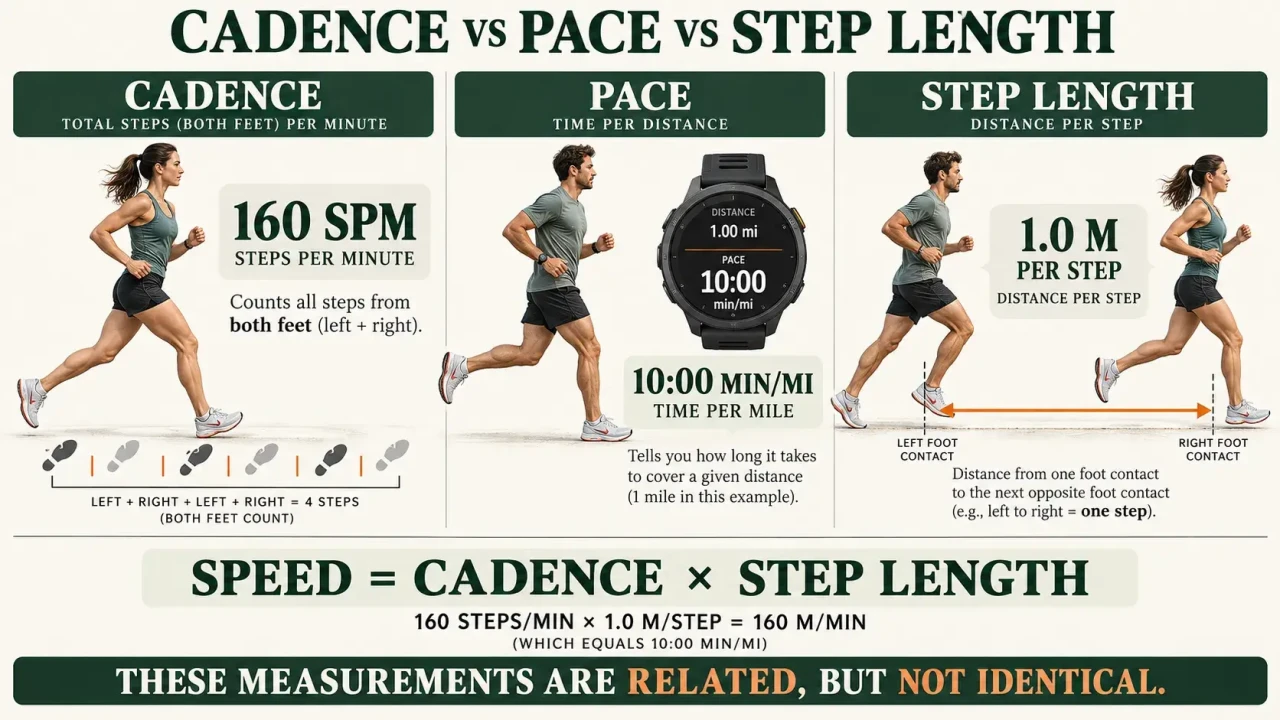
Pace tells you how long it takes to cover a mile or kilometer. Step rate tells you how often your feet land. Step length tells you how far each individual step travels.
For example, 160 steps per minute at one meter per step equals 160 meters each minute, or about 6 miles per hour. At that same speed, moving to 168 SPM means each step must become a little shorter.
Consequently, you can work on cadence without trying to run faster. Also, do not confuse step length with a full stride, which covers two successive steps, one from each foot.
How Cadence Changes Across Different Runs
How to Increase Your Running Cadence
Not everyone needs to increase running cadence.
If you have a specific training goal, a coach has noticed overstriding, or a clinician recommends a change, start with a small, controlled trial.
1. Find Your Natural Rhythm First
Measure your baseline during a few easy runs. Next, choose a comfortable pace for practice, rather than testing a new rhythm during a race or hard workout.
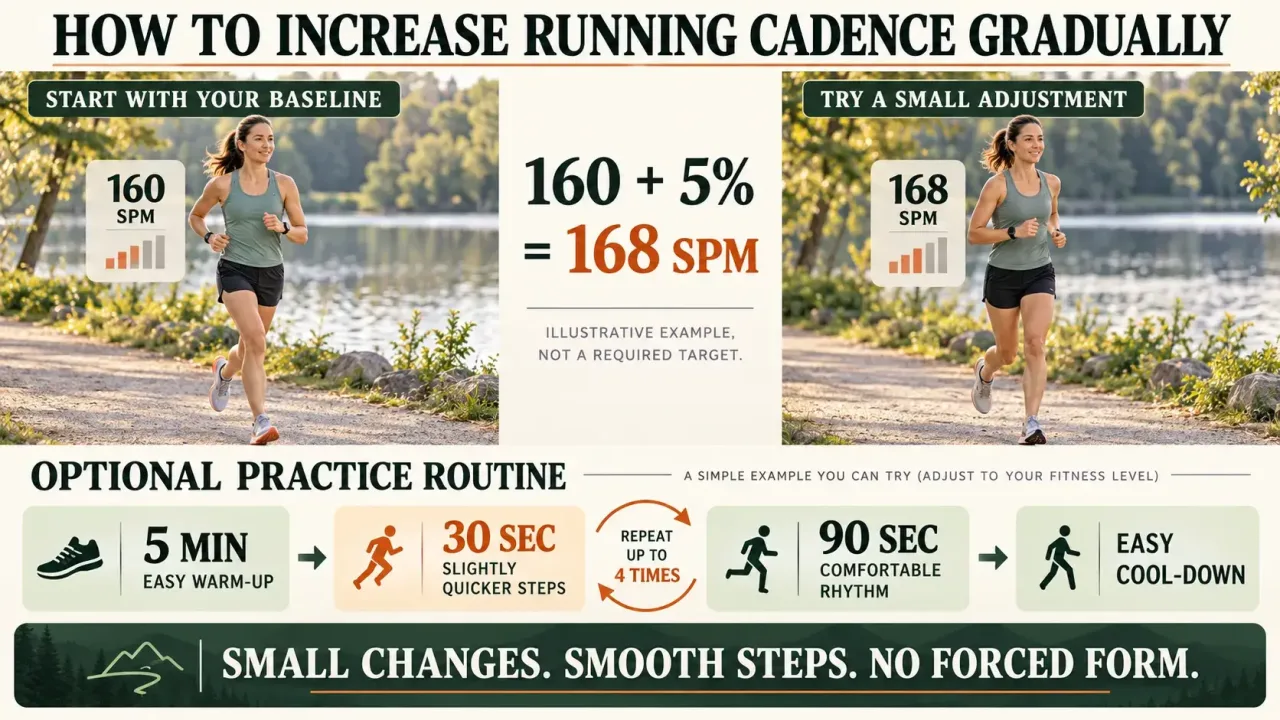
Research often examines modest changes of about 5% to 10%. For example, adding 5% to 160 SPM gives 168 SPM. That calculation is an illustration, not a target you must reach.
2. Take Slightly Shorter, Quicker Steps
At the same speed, a small increase in step rate naturally shortens your steps. Think of a relaxed, smooth rhythm instead of reaching farther ahead.
Keep your shoulders loose and your arms comfortable. Meanwhile, avoid deliberately landing on your toes. Heel striking alone does not mean your form is wrong, and forcing a new foot strike can shift stress elsewhere.
3. Use a Metronome or Music
A metronome gives you a regular beat. Set it to your current cadence first. If an adjustment feels appropriate, try a slightly faster beat for a short section.
For instance, a runner comfortable at 160 SPM could briefly test 168 beats per minute. Match one foot landing to each beat. Music with a matching tempo may also help, although some songs are harder to follow.
Choose a safe practice location and keep audio low enough to hear your surroundings.
4. Add Short Strides and Simple Drills
Strides are brief, controlled accelerations, not all-out sprints. After an easy warm-up, try a few smooth efforts lasting about 20 seconds. Recover fully between them.
Quick-feet drills and gentle skipping can also help you explore rhythm. However, step rate normally rises when speed rises. A fast stride does not prove that your usual easy-run rhythm needs changing.
5. Practice in Short Intervals
Rather than forcing a new rhythm for an entire run, try a small practice block on flat ground:
Jog easily for five minutes to warm up.
Try 30 seconds at a slightly quicker step rate.
Return to your comfortable rhythm for 90 seconds.
Repeat that practice block up to four times.
Finish with easy running or walking.
This is an optional example, not a research-tested prescription. If the change feels smooth, you can extend practice gradually over later sessions. If it feels awkward, reduce the change or return to your usual rhythm.
Can Higher Cadence Prevent Running Injuries?
Not reliably for everyone. Some studies show that modest increases can reduce selected measures of knee loading or braking under controlled conditions. Yet those short-term changes do not prove that more steps per minute will prevent injuries over a full training season.
A 2026 review in Sports Medicine - Open explains why neither 180 SPM nor increasing cadence should be treated as a universal solution. The authors also caution that heel striking is not automatically harmful. Their message is to assess each runner and the reason for changing technique.
If you have recurring knee, shin, or hip pain, do not rely on a cadence target alone. Training load, recovery, strength, and medical history may also matter. A qualified running clinician or physical therapist can help assess persistent symptoms.
Common Running Cadence Mistakes
Even useful measurements can become distracting. These mistakes are worth avoiding:
Chasing 180 on every run: Speed and individual differences affect natural step rate.
Comparing different workouts: A steep trail climb is not the same as a flat recovery jog.
Confusing heel striking with overstriding: They describe different parts of foot landing.
Increasing speed by mistake: To practice a higher cadence at the same pace, let your steps become slightly shorter.
Changing too quickly: Sudden form changes may feel tiring and shift stress to new areas.
Ignoring discomfort: Do not push through pain to meet a watch target.
Most importantly, keep the purpose of your practice clear. If you are already comfortable, running consistently, and progressing, there may be no reason to adjust your step rate.
FAQs
Is 160 SPM a bad cadence for beginners?
No. A reading of 160 SPM may be normal at an easy pace. Your speed, build, and comfort matter more than the number alone.
Can you improve cadence without running faster?
Yes. At a steady speed, slightly quicker steps also need to be slightly shorter. A metronome can help you explore that rhythm.
Does height affect running cadence?
It can. Leg length and body shape may influence natural step rate. However, height cannot tell you the perfect number by itself.
Should cadence stay the same on hills or trails?
No. Slopes and uneven ground change how you move. Let your steps respond naturally to the surface.
Will a higher cadence fix knee pain?
Not necessarily. A technique change may help selected runners, but pain has many possible causes. Seek individual advice if symptoms persist.
Final Thoughts on Running Cadence
At RunWisdom, our approach is to explain what a training number means before recommending a change. Running cadence can help you notice patterns in your stride, but it does not measure fitness or form by itself. Understanding pace, step length, and how your body responds provides a sounder basis for decisions than chasing 180 SPM.
Whether you are preparing for your first 5K or training for longer distances, start with your natural rhythm. Compare similar runs, practice modest changes only when they serve a clear purpose, and stop if discomfort appears. Ultimately, steady training and a comfortable, repeatable stride matter more than any single watch reading.
Medical disclaimer: This article provides general fitness education and does not replace personalized medical advice. Exercise needs vary, especially for people with existing health conditions, injuries, or exercise-related symptoms.


