

Your running watch shows a stride length of 1.05 meters, but an online chart suggests a much larger number for your height. Now you are wondering whether your steps are too short. Worse, you may start reaching farther forward to match a number that was never meant for your running pace.
Understanding average running stride length by height starts with checking what is being measured. Height can influence step length, yet pace, cadence, and the definition of a stride matter just as much. This guide helps you read charts, calculate your own number, and decide whether anything actually needs to change.
What Is the Average Running Stride Length by Height?
There is no single scientifically established running stride average for every height. Taller runners often cover more distance per step, but two people of equal height may move differently at different speeds. So an average running stride length by height chart can give context, not an ideal target.
Height Chart: Walking Estimates, Not Running Averages
You may see charts based on multiplying height by about 0.414. This produces a rough walking step estimate. Doubling it gives a two-step walking stride, not an observed running average.
Method: estimated walking step = height in inches × 0.414; walking stride = twice the step. Rounded to one decimal place. These are illustrative walking calculations, not tested running norms.
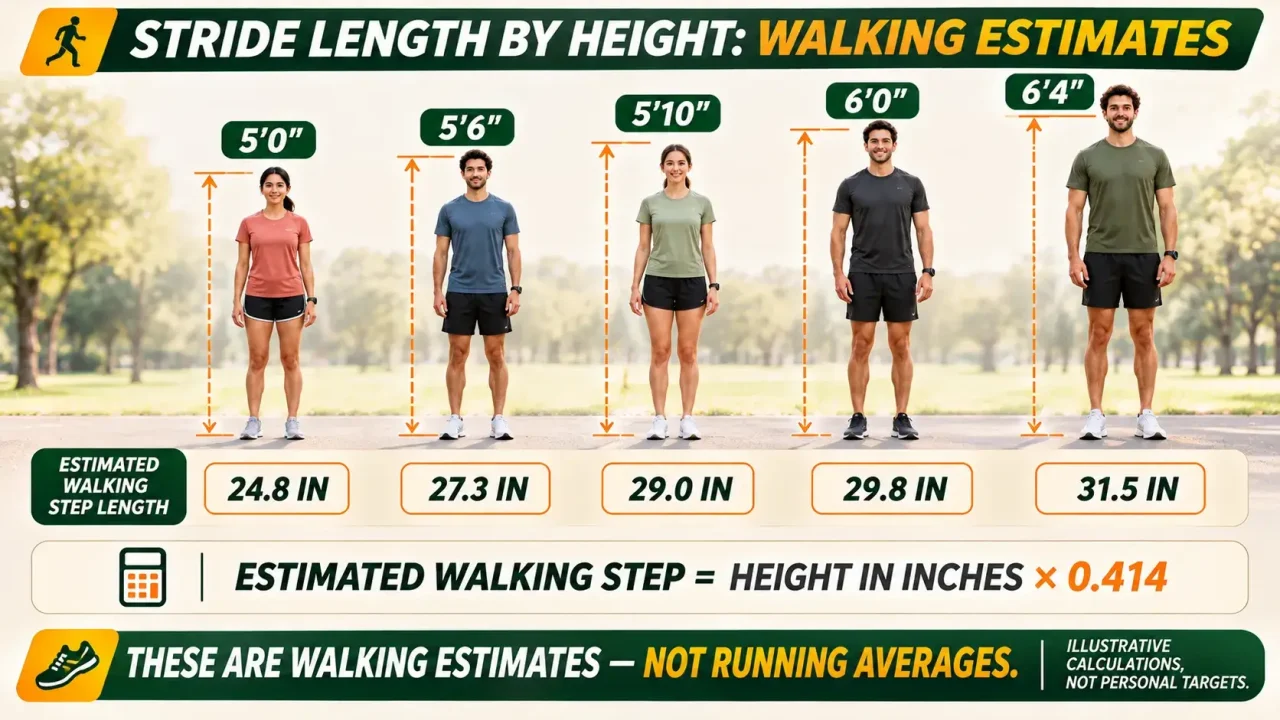
A reliable average running stride length by height reference should distinguish steps from full cycles and walking from running. A running stride length chart should also state the speed or cadence used. Without that context, its numbers are difficult to compare. Below, the running examples use actual pace and cadence calculations instead of claiming one running average for each height.
Step Length vs. Stride Length: What Is the Difference?
In gait science, step length is the distance from one foot landing to the next landing of the opposite foot. Full stride length is the distance between two consecutive landings of the same foot. One full stride contains two steps.
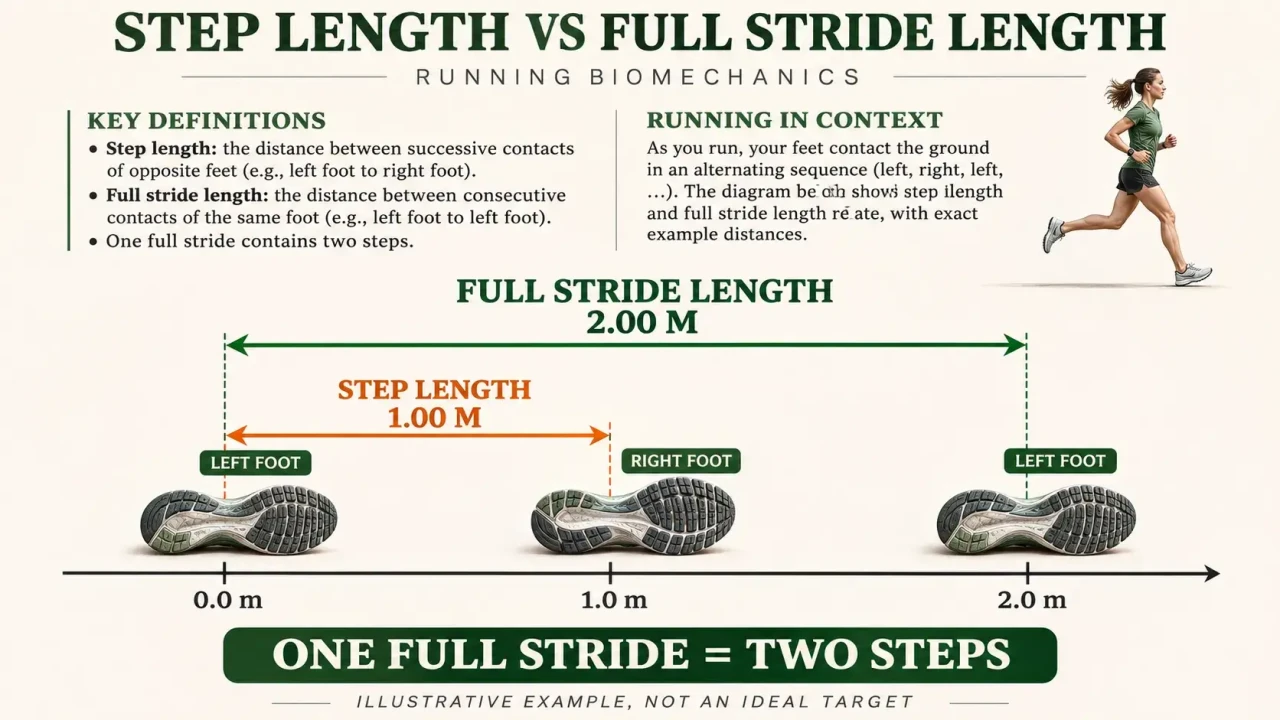
Imagine a left-foot landing, followed by the right foot, then the left foot again. If each step averages 1 meter, the full stride averages 2 meters. Therefore, comparing a step measurement with a full-stride chart can produce an apparent difference of 100%.
Why Your Running Watch Might Show a Different Number
Device labels are not always the same as biomechanics terms. For example, Garmin defines its running-dynamics “stride length” as the distance from one footfall to the next, which is one step under the definition above.
Suppose your watch reports 1.05 meters. If that means consecutive footfalls, your full two-step stride is about 2.10 meters. Check the manual for your own device before using an average running stride length by height reference.
How Much Does Height Affect Running Stride Length?
Body height matters because it often relates to leg length. However, it cannot identify the best stride length for an individual. A 2017 treadmill study of 417 participants found a moderate correlation between height and stride length, while also showing that running measurements depended on speed.
For this reason, average running stride length by height is best understood as a broad comparison. It does not tell you whether you are overstriding or running efficiently. Your own speed and cadence give a more direct measurement. If an average running stride length by height table leaves out the running pace, treat it as a rough reference rather than a form assessment.
Does a Taller Runner Always Take Longer Steps?
No. A six-foot runner moving slowly may take shorter steps than a five-foot-six runner racing at a faster pace. Leg proportions, terrain, and natural running style also vary. Compare running data at similar speeds, not height alone.
How to Measure Your Running Stride Length
You can measure distance per step on a track, or calculate it from pace and cadence. Either approach is more useful than trying to meet a fixed height-based target.
Method 1: Count Steps Over a Known Distance
Warm up, then run at your normal easy pace.
Choose a flat, measured 100-meter section and start moving before the line.
Count every left and right footfall over the measured section.
Divide 100 meters by your step count.
Multiply by two to estimate a full stride.
For example, 100 steps over 100 meters equals 1.00 meter per step and 2.00 meters per full stride. Repeat the test to reduce counting errors. If you count only right-foot landings, remember that you are counting full cycles, not individual steps.
Method 2: Calculate From Pace and Cadence
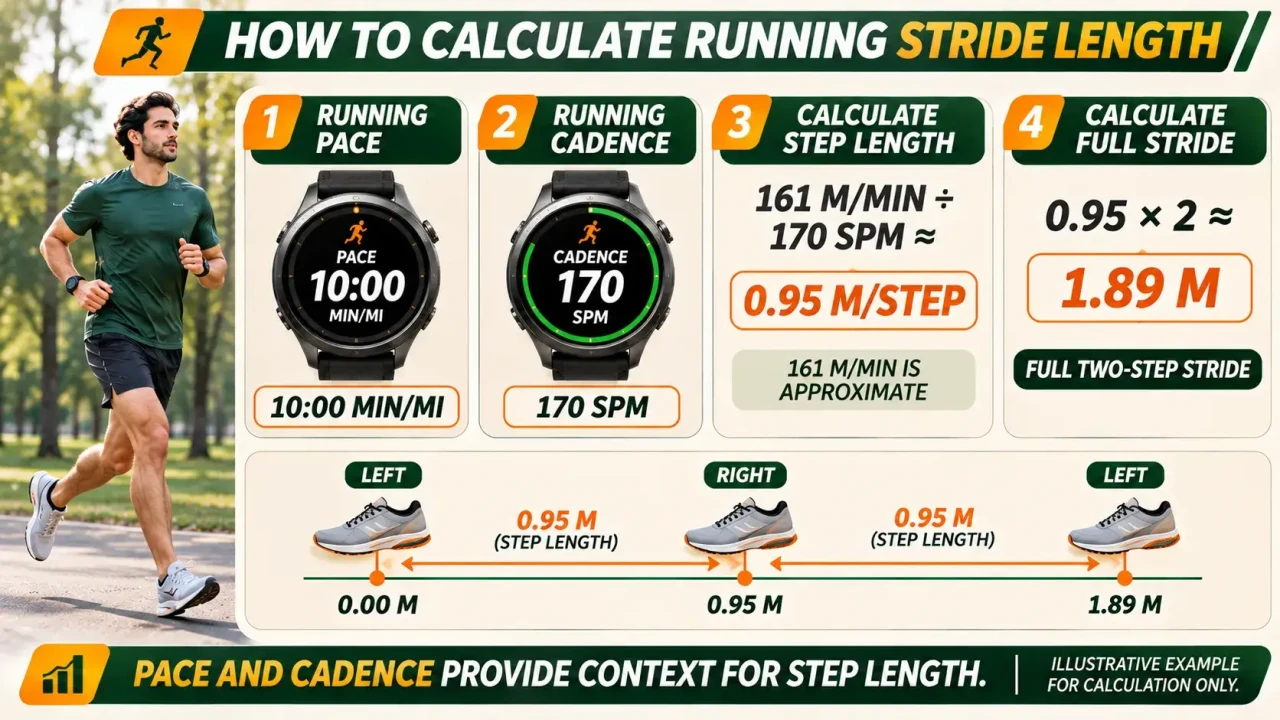
Cadence means steps per minute (SPM). At a known running speed:
Step length = meters per minute ÷ steps per minute
Full two-step stride length = step length × 2
Suppose your pace is 10:00 per mile and cadence is 170 SPM. A mile is about 1,609 meters, so you cover about 161 meters per minute. Divide 161 by 170 and you get 0.95 meters per step. The full stride is about 1.89 meters.
Running Step Length Examples by Pace
These are mathematical examples of distance per step, not average running stride length by height values. Multiply any cell by two for full stride length.
Notice that speed and cadence explain the measurement directly. At the same pace, more steps per minute means less distance per step. At faster speeds, step length or cadence, or both, usually increase.
What Else Changes Your Running Stride?
Your natural stride is not fixed from run to run. Several conditions change it:
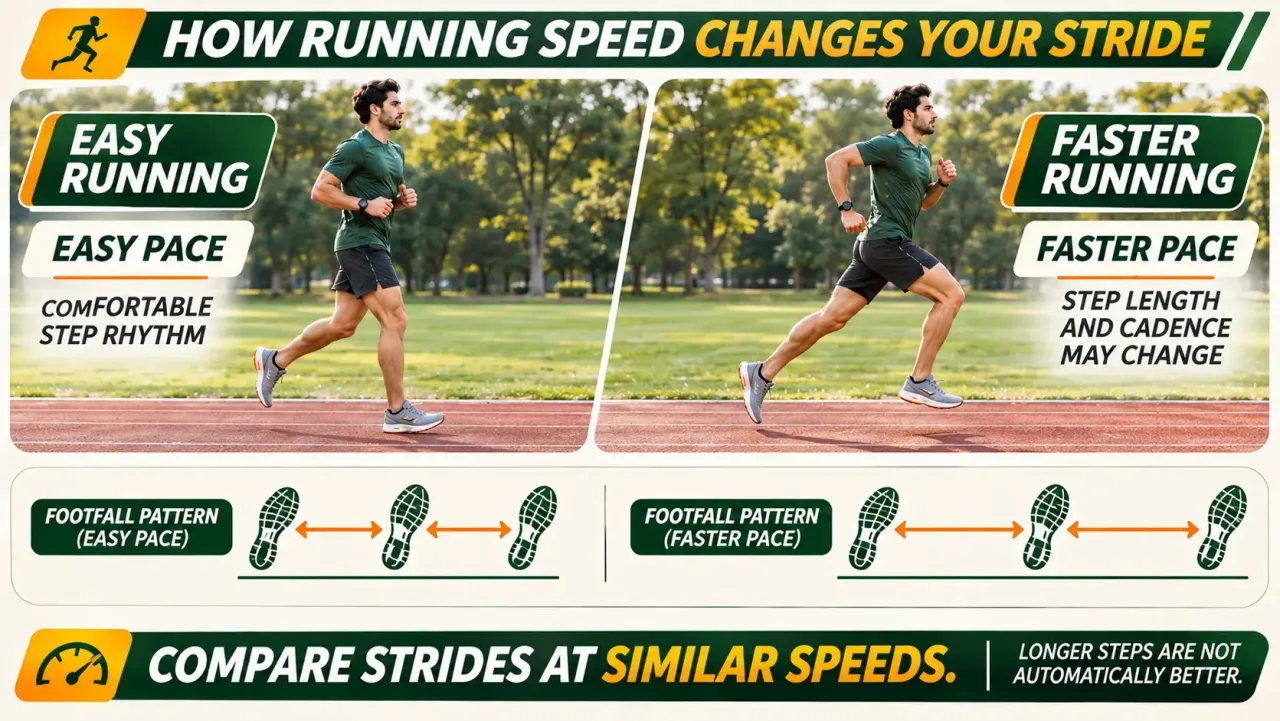
Pace: Faster running usually changes both step length and cadence.
Terrain: Hills and uneven trails can shorten or alter steps.
Fatigue: Running form may change late in a hard workout.
Leg proportions and mobility: People of equal height can move differently.
Strength and experience: Training affects how you control running movement.
Therefore, compare runs completed at a similar pace and on similar terrain. A difference between a hilly trail run and a flat road run does not automatically mean your form is worse.
Is a Longer Running Stride Better?
Not always. A longer step can be part of faster running, but reaching your foot far ahead may create braking forces. This is often called overstriding. You cannot diagnose it simply by comparing your measurement with an average running stride length by height chart.
What Is Overstriding?
Overstriding describes a movement pattern where the landing foot reaches too far ahead of the body. A naturally long step is not automatically overstriding. To judge the difference, you need to consider foot placement, posture, and speed together.
If you feel pain or repeatedly struggle with your form, seek guidance from a qualified running coach or healthcare professional rather than trying to force shorter steps on your own.
Should Everyone Aim for 180 Steps per Minute?
No. The popular 180-SPM number is not a rule for every runner. Cadence changes with pace, height, and individual movement. A comfortable 160 SPM at an easy pace is not automatically worse than 180 SPM.
Research on modest cadence changes has found reductions in some knee and hip loading measures at the same speed. Still, changes in laboratory forces do not guarantee fewer injuries. Avoid treating any single cadence as a universal target.
How to Improve and Track Your Running Stride
First, establish a baseline. Record pace and cadence on a flat, comfortable run. Next, repeat the measurement on a similar route at roughly the same speed. Look for consistent movement and comfort rather than chasing the average running stride length by height.
If a coach identifies a reaching stride, you might practice a small cadence adjustment during short, easy segments. For example, changing from 160 to 168 SPM is a 5% increase. Keep the speed similar and stop if the change causes discomfort. Do not assume everyone needs this adjustment.
Strength training can also support running movement. Glute bridges, step-ups, and calf raises are simple options when suited to your ability. Meanwhile, gradual running practice helps you build control without forcing your legs to reach farther.
Common Stride Length Mistakes
Before interpreting average running stride length by height data, check for these mistakes:
Using a walking chart as a running average: The speeds and movement patterns differ.
Confusing step length with full stride length: This doubles or halves the number.
Ignoring pace: Your stride changes when you speed up.
Comparing different watch definitions: Check your device's metric.
Changing form based on one reading: Repeat measurements and consider comfort.
Assuming longer always means better: An excessively reaching foot can create braking forces.
FAQs
What is the average running stride length by height for someone who is 5'6"?
There is no single measured running average for all runners of that height. Instead, use your pace and cadence to calculate distance per step. For example, 10:00 per mile at 170 SPM works out to approximately 0.95 meters per step, regardless of height.
What about a six-foot runner?
A six-foot runner may have longer legs, but height does not supply one correct stride number. At a given speed and cadence, the calculated distance per step is the same for runners of any height.
Does a shorter stride mean poor running form?
No. The right step length depends on your speed, cadence, and movement. A short step at an easy pace can be completely normal.
Is the stride length on my watch the same as a full stride?
Not necessarily. Some devices report distance between consecutive footfalls while calling it stride length. Consult your device's definition before comparing it with a full two-step measurement.
How can I increase running speed without overstriding?
Build fitness gradually and avoid reaching the foot far forward. Both cadence and step length can change naturally as pace increases. If pain or form problems continue, a qualified coach can assess your movement.
Final Thoughts
Average running stride length by height is useful for understanding broad differences between runners, but it cannot define your ideal technique. A chart may offer a starting point. However, the more helpful numbers come from your own pace, cadence, and correctly defined step or full-stride length.
At RunWisdom, our practical recommendation is to measure first and change form only when there is a good reason. Compare similar runs, watch for discomfort, and allow your stride to develop as fitness improves. That approach is more reliable than trying to match a height-based number that may describe walking rather than running.
Medical disclaimer: This article provides general fitness education and does not replace personalized medical advice. Exercise needs vary, especially for people with existing health conditions, injuries, or exercise-related symptoms.


