
You start running with the goal of going farther, but your breathing gets heavy after only a few minutes. Your legs feel tired, and another walking break seems unavoidable. Even when you push harder, the next workout doesn't feel any easier. Meanwhile, watching experienced runners cover miles without stopping can make your progress feel disappointing. Starting too fast or increasing your running time too quickly may only make things harder.
Learning how to build running endurance as a beginner doesn't mean forcing yourself through exhausting workouts. Instead, start with a comfortable pace, planned walking breaks, and gradual increases in running time. This guide explains how to improve stamina, choose the right starting point, recognize when you're ready to progress, and track your endurance without rushing or ignoring recovery.
Key Takeaways
Why Do Beginners Get Tired So Quickly When Running?
Running requires your heart, lungs, muscles, and energy systems to work together.
During exercise, your breathing and heart rate increase to help supply working muscles with oxygen. Meanwhile, those muscles use energy to keep your body moving.
For someone new to running, even a short jog can require considerable effort. As a result, breathing becomes faster and the legs may tire sooner than expected.
Regular aerobic exercise can improve your ability to sustain activity. However, the rate of improvement depends on previous fitness, training load, recovery, and individual health.
What Is Running Endurance?
Running endurance is your ability to maintain running activity over time.
For a beginner, improving endurance might mean jogging for five minutes instead of two. Another runner may progress from short running intervals to fifteen minutes of comfortable, continuous jogging.
Endurance and speed are related but different.
Someone can improve running duration without becoming noticeably faster. Similarly, being able to run a short distance quickly doesn't necessarily mean that pace can be maintained over several miles.
When endurance is your priority, focus on extending the time you can run at a manageable effort.
Why Your Running Effort May Change
Not every difficult workout has the same cause.
Heavy breathing early in a run may suggest that your pace is too demanding. On the other hand, tired legs may reflect unfamiliar muscle activity, hills, or incomplete recovery.
Sometimes a run begins comfortably but becomes difficult later. In that situation, the session may be longer or harder than your current fitness supports.
Weather also affects effort. For example, jogging in hot, humid conditions can feel much more demanding than running on a cool morning.
Before increasing your workload, consider what makes your current sessions difficult.
These observations can guide training adjustments, but they cannot diagnose medical conditions.
How to Build Running Endurance Step by Step
Improving running stamina requires manageable exercise, regular practice, and suitable recovery.
The following five methods explain how beginners can increase running time without turning every workout into a maximum-effort test.
1. Start With Easy, Conversational Running
Running too fast is a common reason beginners become exhausted early.
During the opening minutes, your legs may feel fresh. Consequently, increasing your speed can seem comfortable.
However, heavy breathing and muscle fatigue may develop as the session continues.
Starting slowly helps you control your effort and avoid using too much energy early in the workout.
Use the Talk Test to Find Your Effort
One useful way to control your running effort is the talk test. According to the CDC's official guide to measuring physical activity intensity, people doing moderate-intensity exercise can usually talk but not sing. During vigorous activity, speaking more than a few words without pausing becomes difficult. However, running intensity varies with fitness, and even slow jogging may feel vigorous to a beginner. For an easy session, choose a manageable effort and slow down or take walking breaks when your breathing becomes too difficult.
There is no need to match another runner's speed.
A comfortable running effort may feel unusually slow at first. Nevertheless, learning to control that effort is useful when your goal is to spend more time running.
Practical tip: Begin the first few minutes slowly. Check your breathing before deciding whether to maintain or adjust your pace.
2. Use Run-Walk Intervals to Build Stamina
Planned walking breaks are a normal part of many beginner running programs.
Instead of jogging continuously until you're exhausted, alternate short running periods with walking recovery.
This approach allows beginners to practice manageable running efforts during a longer overall exercise session.
For example, an introductory workout might include:
Walk comfortably for five minutes.
Jog easily for one minute.
Walk for two minutes.
Repeat the intervals as tolerated.
Finish with several minutes of easy walking.
These timings are examples, not a required workout for everyone.
If one minute of jogging feels too difficult, shorten the running interval. Alternatively, extend the walking period.
Once the current intervals feel manageable, consider adding a little running time.
For example, a person who comfortably completes one-minute jogging intervals might try ninety seconds during a later session.
Keep the effort controlled rather than sprinting between walking breaks.
Gradually, some runners find they can jog longer before needing to walk again.
3. Increase Running Time Gradually
After familiar sessions become manageable, consider a modest increase in running duration.
However, avoid changing several training variables at once.
Increasing distance, speed, and weekly running frequency together creates a larger workload.
Instead, adjust one major part of your routine and observe how your body responds.
For beginners, measuring exercise by time may be easier than tracking mileage.
Suppose someone can comfortably jog for five minutes. Rather than immediately attempting fifteen minutes nonstop, a slightly longer interval may be appropriate when recovery allows.
Repeating the same duration is another option.
Both approaches can support a sensible training routine.
Should Beginners Follow the 10% Rule?
The 10% rule suggests limiting weekly running increases to around ten percent.
However, research hasn't established this as a universal injury-prevention rule.
Previous fitness, overall workload, and recovery affect how people respond to training. Therefore, a fixed percentage shouldn't be treated as a guarantee of safety.
If current sessions remain difficult, repeat them before increasing the workload.
Better habit: Review your effort and recovery whenever you make a meaningful change to your running routine.
4. Add a Longer Run When You're Ready
A longer session gives you an opportunity to practice running for more time.
However, a beginner's long run doesn't need to cover several miles.
It simply means a manageable session that lasts somewhat longer than your usual workout.
For example, someone comfortable with fifteen minutes of easy jogging may eventually attempt a slightly longer run.
Keep the pace relaxed and use walking breaks when needed.
Additionally, there's no reason to extend your longest session every week.
Repeating a familiar duration can help develop confidence and steady pacing.
If a longer workout leaves you unusually tired or affects the next session, reduce its duration.
The purpose is to build the ability to sustain activity, not repeatedly test your limits.
5. Build a Consistent Weekly Routine
Endurance develops through repeated activity over time.
However, running every day isn't necessary for beginners.
Two or three manageable weekly sessions may suit many new runners, although individual needs vary.
For example, someone might run on Monday and Thursday, leaving recovery time between workouts.
Another person may prefer three nonconsecutive running days.
Neither schedule is automatically better.
Choose a routine that fits your fitness, responsibilities, and recovery needs.
Furthermore, consider your other physical activities. Sports, strength training, and physically demanding work can add to your overall fatigue.
If planned workouts regularly become difficult to complete, simplify your schedule.
A routine you can maintain is more useful than an ambitious plan that repeatedly leaves you exhausted.
Beginner Running Endurance Training Plan
A useful training plan should begin at your current ability.
Someone who struggles to jog for thirty seconds needs a different starting point from someone who already runs comfortably for fifteen minutes.
Before following a progression, consider which category describes your current fitness.
Choose the Right Starting Level
These are practical examples, not medical fitness classifications.
Choose a level that matches your ability rather than forcing yourself into a harder schedule.
For example, someone comfortable with fifteen minutes of running may not need one-minute jogging intervals.
Conversely, a person who struggles with short jogging periods may need more walking recovery.
Example Four-Week Run-Walk Progression
When Should You Increase, Repeat, or Reduce Training?
What If You Miss a Week of Training?
Busy schedules, travel, and illness may interrupt your routine.
After missing several sessions, avoid trying to complete every missed workout.
Instead, return with an easier session and assess how it feels.
A longer break may require reducing your previous running time.
If the break involved illness or injury, follow suitable medical guidance when necessary.
The goal is to return at a workload that matches your present ability.
Strength Training and Cross-Training for Endurance
Running remains the main activity when your goal is to improve running endurance.
However, other exercises can support general fitness and add variety.
Strength training develops muscles involved in movement. Meanwhile, cross-training provides opportunities for different types of aerobic activity.
Strength Exercises for Beginner Runners

Running involves repeated work from the hips, thighs, calves, and trunk.
Strength exercises can help develop these muscle groups.
Beginner-friendly options include:
Bodyweight squats: Work the thighs and hips.
Calf raises: Strengthen the calf muscles.
Glute bridges: Train muscles around the hips.
Step-ups: Practice controlled single-leg movement.
Bird dogs: Challenge trunk stability and coordination.
Start with movements you can perform comfortably.
Focus on controlled technique rather than using heavy weights.
Additionally, consider how strength training affects your next running session.
A demanding leg workout may cause soreness, particularly when the movements are unfamiliar.
Allow recovery when needed.
Strength training supports general fitness, but it doesn't guarantee injury prevention.
Cross-Training Options
Cross-training involves activities other than your main sport.
Walking, cycling, swimming, and elliptical exercise are common options.
For example, comfortable cycling provides aerobic activity without repeating the same running movement.
Walking can also help maintain general activity.
However, intensity still matters.
A demanding cycling workout can create considerable fatigue, even though it isn't a run.
Therefore, choose activities that suit your fitness and recovery needs.
If cross-training takes place on a recovery day, keep its effort appropriate.
Recovery, Sleep, Nutrition, and Hydration
Training creates a physical challenge. Recovery gives your body time to respond.
Without suitable rest and general health habits, familiar running sessions may become harder to manage.
Why Recovery Days Matter

Running places repeated demands on muscles and other tissues.
For beginners, recovery between sessions can be especially important because the activity may be unfamiliar.
However, rest doesn't always mean complete inactivity.
Comfortable walking or gentle cycling may be suitable if you feel well.
On the other hand, significant soreness or unusual fatigue may indicate that rest is more appropriate.
Avoid making every recovery day another demanding training session.
Additionally, consider physical activity outside your running plan. Sports and physically demanding work can increase your total workload.
Sleep and Endurance
Poor sleep can affect how exercise feels.
For example, a familiar running session may seem more difficult after several nights of inadequate rest.
Aim for regular, sufficient sleep.
If you're unusually tired, consider reducing your planned workload.
Good sleep supports overall health and recovery, but it doesn't replace appropriate training.
Eating Before and After Runs
Most short beginner runs don't require energy gels, special sports drinks, or expensive supplements.
Regular meals can support the needs of many new runners.
If you're hungry before exercise, a familiar snack may help.
Simple choices include toast, a banana, or oatmeal.
However, digestion varies. Choose foods that agree with your stomach and allow suitable time before running.
Afterward, return to your normal eating routine.
Adequate overall nutrition matters more than purchasing specialized products for every short workout.
Staying Hydrated
Fluid needs vary with temperature, sweating, workout duration, and individual health.
For short runs in mild conditions, regular hydration may be sufficient.
However, hot weather and longer workouts may require more careful fluid planning.
Consider carrying water when conditions make it useful.
Avoid forcing excessive fluid intake.
If you feel unwell in the heat, stop exercising and respond appropriately.
Common Mistakes That Slow Endurance Progress
Why Harder Isn't Always Better
A longer or faster run can feel rewarding.
However, attempting a new personal record during every workout may make training difficult to sustain.
Instead, practice completing manageable sessions.
Use occasional comparisons between similar workouts to evaluate improvement.
The purpose of endurance training isn't to finish every session completely exhausted.
It's to develop the ability to maintain activity over time.
How Long Does It Take to Improve Running Endurance?
Some beginners notice familiar workouts becoming easier after several weeks of regular activity.
However, improvement doesn't happen at the same rate for everyone.
Someone who struggles to jog for two minutes has a different starting point from someone who comfortably runs for fifteen minutes.
Previous fitness, training load, recovery, and overall health can all influence progress.
Therefore, avoid expecting to reach a particular distance by a fixed date.
Repeating a manageable workout can still support your development.
Signs Your Endurance Is Improving
Useful signs include:
Familiar jogging intervals feel easier.
Comfortable running time increases.
Fewer walking breaks are needed during similar sessions.
Recovery becomes more manageable.
Regular running feels easier to maintain.
For example, jogging comfortably for five minutes may represent better progress than forcing yourself through eight exhausting minutes.
A longer workout isn't automatically more useful.
Instead, consider both duration and effort.
How to Track Your Running Endurance Progress
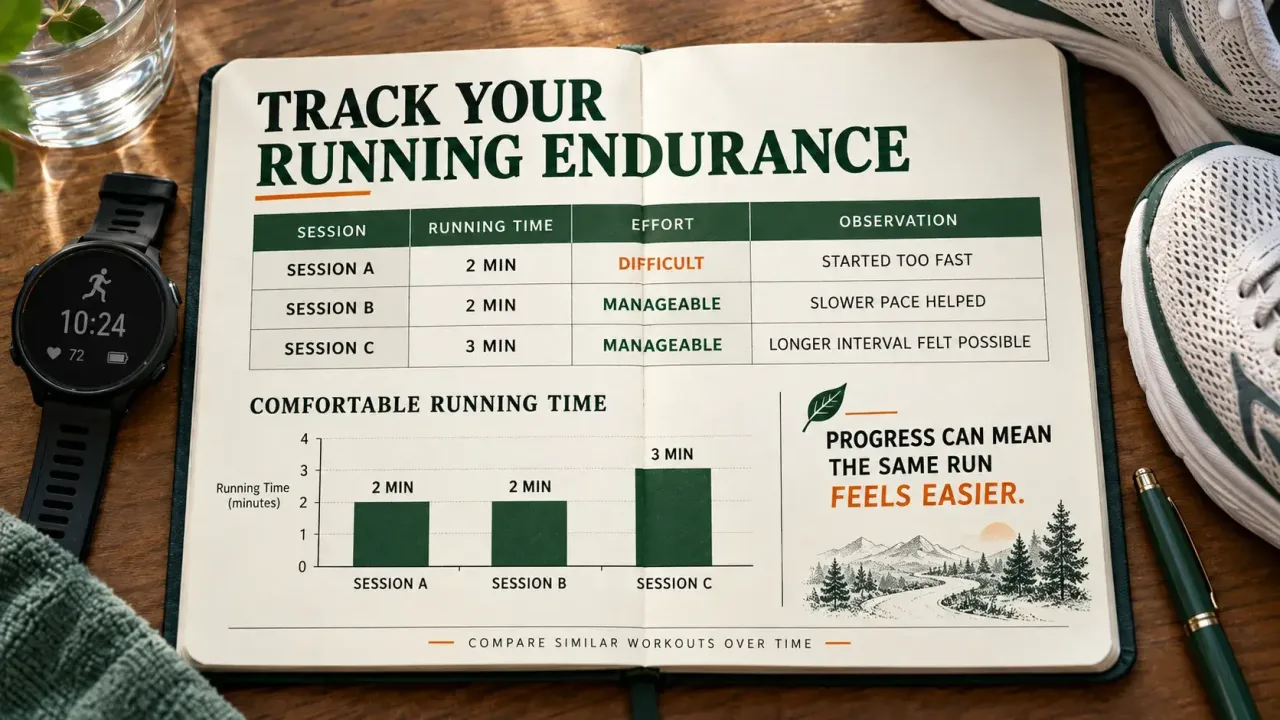
A simple training log can help you recognize changes over time.
You don't need an expensive watch or specialized fitness app.
Record the time you can jog comfortably, walking breaks, perceived effort, and recovery.
Review Your Results Every Two Weeks
Compare similar workouts instead of judging improvement after one run.
Ask yourself:
Can I jog longer at a manageable effort?
Do I need fewer walking breaks?
Does my usual running pace feel more comfortable?
Am I recovering well before the next session?
Is my weekly routine realistic?
Consider weather and route differences when comparing sessions.
For example, running uphill in hot weather may feel harder than jogging on flat ground in cooler conditions.
If your usual workout becomes easier and recovery is comfortable, a small increase may be appropriate.
However, when the session remains difficult, repeat it or reduce the workload.
Practical tip: Use a similar route and effort when comparing workouts. This makes changes in running comfort easier to recognize.
When Should Beginners Add Speedwork?
Speedwork includes structured periods of faster running.
Examples include short intervals and tempo sessions.
These workouts may become useful later, but they aren't essential for someone who struggles to maintain easy jogging.
Initially, focus on comfortable running time and regular training.
Once familiar easy sessions become manageable and recovery is going well, faster workouts may become appropriate.
However, faster running adds training stress.
There's no need to introduce speedwork simply because experienced runners use it.
What About Hills and Strides?
Hills increase the effort required to run.
Strides involve short periods of controlled, faster running.
Both can appear in more developed training programs.
However, if easy running on flat ground remains difficult, build that foundation first.
Mental Strategies to Keep Running Longer
Endurance training also involves learning how to manage ordinary exercise effort.
However, determination should never mean ignoring significant pain or unusual symptoms.
Break Longer Runs Into Smaller Parts
A twenty-minute workout may feel overwhelming when you're used to short jogging intervals.
Instead of focusing on the entire session, concentrate on the next manageable interval.
Complete the planned jogging period, take your walking break, and reassess your effort.
This approach can make longer workouts easier to manage mentally.
Choose Comfortable Routes
A familiar route can help you judge your effort.
For example, a relatively flat path may make pacing easier than a route with steep hills.
Choose safe surroundings where you can focus on your workout.
If you run near traffic, remain alert to vehicles and other road users.
Find Support Without Competing
Running with a friend may make exercise more enjoyable.
However, choose someone willing to match your pace.
Trying to keep up with a faster runner can make an easy session unnecessarily difficult.
Instead, focus on your own progress.
If three minutes of jogging now feels comfortable when it previously felt difficult, that change matters.
When to Stop Running or Seek Medical Advice
Some tiredness and mild soreness can occur when beginning unfamiliar exercise.
However, sharp pain, significant swelling, or worsening discomfort shouldn't be ignored.
Stop running if pain changes your movement or unusual symptoms develop.
Chest pain, fainting, or severe unexplained breathing difficulty during exercise requires urgent medical attention.
Persistent unusual fatigue or breathlessness should also be assessed by a healthcare professional.
If you're returning after injury or illness, individualized guidance may be necessary.
Building endurance requires appropriate training challenges, not pushing through warning signs.
FAQs
How long does it take to build running endurance?
Some beginners notice familiar workouts becoming easier after several weeks of consistent activity. However, improvement depends on previous fitness, training load, recovery, and health. Repeat manageable sessions when necessary rather than expecting results by a fixed deadline.
Is walking during a run okay for beginners?
Yes. Planned walking breaks can help beginners manage effort and complete longer overall sessions. As fitness improves, jogging intervals may become longer. Walking is a useful training option, not a sign of failure.
How many days a week should beginners run to improve endurance?
Two or three manageable weekly running sessions may suit many beginners, although individual needs vary. Allow suitable recovery between demanding workouts. Choose a schedule based on your fitness, available time, and how well you recover.
Should I run faster or longer to improve endurance?
When endurance is your main goal, focus first on extending the time you can run at a manageable effort. Faster running increases intensity and may make workouts harder to sustain. Speed-focused sessions can be considered later as fitness develops.
Why do I get tired after only a few minutes of running?
Starting too fast, limited aerobic fitness, hills, heat, and poor recovery can make short runs feel difficult. Try slowing down, using walking breaks, and reviewing recent training. Seek medical advice if fatigue or breathlessness is unusual or continues despite easier activity.
When should beginners introduce speed training?
There's no universal timeline. First, develop a comfortable running routine and suitable recovery. Faster workouts may become appropriate as training experience increases. Qualified coaching can help if you're unsure how to progress.
Conclusion
Building running endurance takes patience, and improvement doesn't follow the same timeline for everyone. A comfortable pace, planned walking breaks, gradual training, and proper recovery can help you run longer over time. Established beginner exercise guidance supports starting at a manageable level and increasing activity gradually. Instead of measuring success only by distance or speed, pay attention to how easily you complete familiar workouts and how well you recover afterward.
At RunWisdom, we focus on sharing practical running advice informed by reliable exercise and health information. Choose one manageable endurance goal for your next two weeks of training. Track your comfortable running time, notice changes in walking breaks and effort, and adjust your workouts based on recovery. The goal isn't to run as far as someone else. It's to build endurance that matches your fitness and helps you enjoy running.
Medical disclaimer: This article provides general fitness education and doesn't replace individualized medical advice. People with injuries, health conditions, or unusual exercise-related symptoms may need guidance from a healthcare professional.